
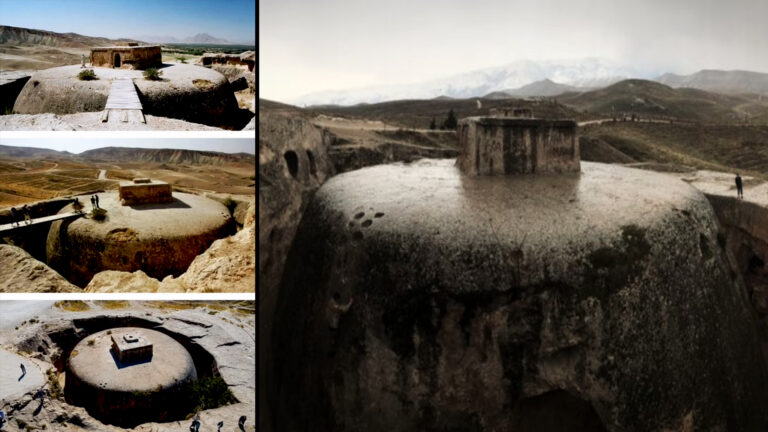

In northern Afghanistan’s Samangan Province lies a strange underground monument that has confounded explorers and historians alike. Known as Takht-e Rostam (Persian for “Throne of Rostam”), this ancient complex looks from above like a modern bunker or fortification — a square pit surrounded by deep trenches.
The official story says it’s a 1,500-year-old Buddhist stupa carved in the 4th or 5th century AD. But the more you look at it, the less that story makes sense.

A Stupa Unlike Any Other
For starters, this isn’t just another Buddhist monument. Most stupas were built above ground — brick upon brick, plastered over and adorned. This one, however, is carved straight down into the bedrock, as if someone took a giant ice-cream scooper to the hilltop.
And not just a shallow hollow — we’re talking about a massive circular pit, about 8 meters deep, surrounding a solid domed core. You have to descend into it, almost like entering a fortified bunker.
Why build it this way? The mainstream answer is vague — maybe for shade from the Afghan sun, maybe for camouflage from raiders. But neither explanation really sticks. If it was just about hiding or keeping cool, why don’t we see dozens of these across ancient Afghanistan? Why is Takht-e Rostam the only one like it?
Then there’s the craftsmanship. This is monolithic engineering — cut from a single chunk of stone, with perfect geometric planning. The trench, the stupa, the surrounding rock-cut caves — it’s all laid out in a way that screams planning first, carving second.

Could Takht-e Rostam Be Far Older Than Believed?
Imagine some prehistoric builders — long before the Persians, before the Buddhists, before even the first written word in Bactria — cutting this into the rock.
Now, jump forward a few thousand years. Along came traveling Buddhists, spreading north from India. They find this strange, perfectly shaped pit with a domed center and carved chambers. To them, it looks like a sacred place already — so why not use it? They turn it into a stupa, dedicate it to their faith, and leave behind a handful of Buddhist traces.
Centuries later, historians arrive and see the Buddhist layer — and assume that’s the origin story. But if you strip away that layer, you’re left with something that doesn’t match the Buddhist toolkit at all.
No other stupa in Afghanistan is cut into the ground like this. None is monolithic. None has the same flood-erosion scars. And here’s the kicker — there’s no inscription naming its builder, no royal decree, and no founding legend that fits. Even the Persian epic connection — linking it to Rostam, the legendary hero — hints that people already saw this place as ancient and mysterious a thousand years ago.
Mainstream archaeology loves tidy boxes. Takht-e Rostam doesn’t fit in one. Which is why the safest academic thing to do is to shrug and say, “Oh, it’s just a Buddhist site.” But the stones tell a deeper story. They whisper of a time when people were carving not for gods, but for survival — when a coming disaster might have been the most sacred thing you could prepare for.
Could it really be that old? Could this be a remnant of some Ice Age civilization — one that mainstream history says never existed? We can’t prove it. But we also can’t rule it out. And given how unique it is, the burden of proof might now lie with the mainstream, not with the alternative thinkers.
Monolithic Perfection and Ancient Engineering
The Takht-e Rostam complex is unlike anything else in Afghanistan’s archaeological record, and its characteristics make it both unique and suspiciously out of place for the time period mainstream scholars assign to it.
The most striking feature is its monolithic construction — the entire complex is carved directly from the living bedrock, likely sandstone, with no separate building blocks, mortar, or visible joints.
Instead of rising above the ground like almost every other stupa in Central and South Asia, it sinks into the earth in the form of a massive circular trench, roughly 8 meters (26 feet) deep, cut with remarkable precision around a solid domed core that forms the central stupa.
This central mass is perfectly geometric, showing an understanding of symmetry and proportion that would be difficult to achieve without detailed pre-planning. Surrounding the trench walls are five rock-cut caves and a number of smaller monastic cells, all hewn into the stone with smooth, deliberate surfaces.
Some of these chambers have small circular openings in their roofs to let in shafts of daylight, creating a dim, meditative twilight inside — or, alternatively, allowing for ventilation if the structure had a more practical, pre-Buddhist purpose.
In one chamber, there is even a domed ceiling which was later adorned by the Buddhists with lotus-leaf carvings, though most of the interiors are undecorated.

The trench itself is deep and narrow enough to act as a defensive barrier, making the stupa core difficult to approach except via a designated path — a design far more in line with fortification or refuge than purely religious architecture.
The sheer effort required to carve such a structure — removing thousands of tons of stone with hand tools, while keeping the geometry precise and the trench perfectly circular — indicates advanced engineering skills and long-term planning.
Combined with the fact that no inscriptions, builder’s marks, or contemporary records exist to tie it definitively to its supposed 4th- or 5th-century Buddhist origin, the physical characteristics themselves raise the possibility that Takht-e Rostam could predate its accepted historical context by thousands of years, with the Buddhists merely inheriting and adapting an already ancient, enigmatic monument.
The Persian Epic Connection: The Throne of Rostam
Its Persian name, “Throne of Rostam,” comes from the epic Shahnameh (Book of Kings), written by the poet Ferdowsi around 1010 CE. In that epic, Rostam is a Hercules-like hero of ancient Persia.
One famous story tells of Rostam traveling to Samangan (the local kingdom) and marrying Princess Tahmina, the daughter of the king. According to local folklore, Takht-e Rostam was the very place where this legendary wedding took place.
In fact, one legend says Rostam celebrated his nuptials by drinking wine from the basin atop the stupa itself. Of course, this is a fanciful retelling — the “basin” could be a reference to the square harmika on the summit of the stupa, repurposed in imagination as a drinking bowl.
Such myths arose precisely because people found the site mysterious — they saw a grand stone structure and trenches but had no idea who built it or why, so they attributed it to epic heroes of the distant past.
Across Afghanistan, it’s common for unusual ancient mounds or ruins to be linked to Rostam’s exploits. In this way, the memory of the Buddhist monastery was replaced by Persian folklore during the Islamic era.
Even the name “Takht-e Rostam” reflects this shift: a takht or throne implies a royal or heroic seat, not a religious shrine.
Engineering Genius and Design Mysteries
Part of what makes Takht-e Rostam so fascinating is the sheer engineering skill and effort it represents. Why would anyone carve a stupa down into the earth rather than build it up?
This was an enormous undertaking: laborers had to remove tons of rock to hollow out the trench and caves, painstakingly leaving a cylindrical core of stone in the middle to form the domed stupa.
An innovative drainage system was carved into the rock to channel away rainwater that might collect in the pit. The builders clearly had advanced knowledge of stone excavation and architecture.
Perhaps the most curious detail noted by alternative researchers are certain erosion patterns on the rock walls.
The exterior of the stupa and parts of the trench show rounded, smoothed surfaces that look a bit like water-wear. Yet Samangan’s climate today is arid — the region gets only 100–400 mm of rain per year, not enough to cause significant water erosion on limestone.
For such marks to appear, it would either take a very long time (tens of thousands of years of normal weathering) or a short period of intense flooding.
This has led to a wild hypothesis: what if Takht-e Rostam’s sunken design actually allowed it to survive an ancient flood?
A few authors have speculated that it might have been some kind of prehistoric flood shelter — essentially a giant stone life-boat on land, built to protect a group of people during a catastrophic deluge.
According to this theory, the solid rock walls of the structure could keep water out for a time, like a bunker. Calculations based on the porosity of the local sandstone suggest water would slowly seep through the 8-meter-thick walls, taking around 7–8 days to penetrate fully — enough time for floodwaters to recede in a mountainous area.
Two people sealed inside could have enough air to survive about 20 days, or a family perhaps a week, before needing fresh air. Proponents of this idea point to Takht-e Rostam’s elevation (around 1000 meters above sea level, at the foothills) as a strategic spot — high enough that floodwaters would drain away relatively quickly.
Does this mean that some kind of pre-historic civilization carved out this refuge to ride out a great flood, which later generations converted into a temple?

Between Legend and Archaeology
To be clear, no scientific evidence currently supports the flood-bunker theory — it veers into the realm of legend. Geologists have not dated the erosion here to 10,000+ years ago, nor is there direct evidence of a massive flood in this exact locale.
Still, the fact that people even entertain this scenario speaks to how unique and mysterious Takht-e Rostam is.
It’s true that northern Afghanistan has been inhabited since at least 10,000 BC, so in principle an earlier civilization could have worked the site. The legendary hero Rostam himself is often thought of as a remnant of prehistoric memory in folklore, hinting at very ancient events.
It’s tantalizing to think that perhaps the “Throne of Rostam” gained its name because even medieval Persians sensed the site was far older than them — a work of giants from a long-forgotten age.

A Mystery That Redefines History
In summary, these alternative ideas — whether viewing Takht-e Rostam as a flood-era bunker or an unfinished ancient tomb — challenge us to think beyond the conventional timeline.
They haven’t been proven, but they underscore how little we truly know about this site’s early history.
The lack of written records means almost all conclusions about Takht-e Rostam’s origin are based on interpreting the architecture itself and the few artifacts around it.
Could Buddhist monks in the 4th century have discovered an existing rock-cut complex (from who-knows-when) and repurposed it as a monastery? It’s not impossible.
We know that throughout history, sacred sites are often built on the bones of older structures — churches atop pagan temples, mosques atop churches, and so on. Perhaps this remote hillside in Afghanistan held significance long before Buddhism arrived.
Until more evidence emerges, however, the scholarly consensus remains that Takht-e Rostam was a product of the late Kushan period — showcasing an ingenious and mysterious variation on Buddhist architecture that continues to puzzle and inspire to this day.