

Far from the bustling tourist paths that lead to Machu Picchu or Ollantaytambo, deep in the Andean highlands of Peru’s Sacred Valley, lies a mysterious archaeological site shrouded in myth and speculation. Known as Naupa Huaca — often translated as Ancient Sacred Place — this secluded rock-cut monument continues to puzzle archaeologists, researchers, and spiritual explorers alike.
Believed by some to predate the Inca civilization by thousands of years, Naupa Huaca reveals an astonishing level of craftsmanship and precision that seems almost impossible for its supposed era. Halfway up a steep ravine, an inverted V-shaped entrance carved into the mountainside invites the curious to explore. But the mystery deepens once you step inside — the entrance is blocked by rubble and reinforced stonework, preventing anyone from accessing whatever lies beyond.
Were the Incas trying to protect something sacred — or something dangerous — within? The true purpose of Naupa Huaca remains one of the great enigmas of the Andes.

The Laser-Like False Door of Naupa Huaca
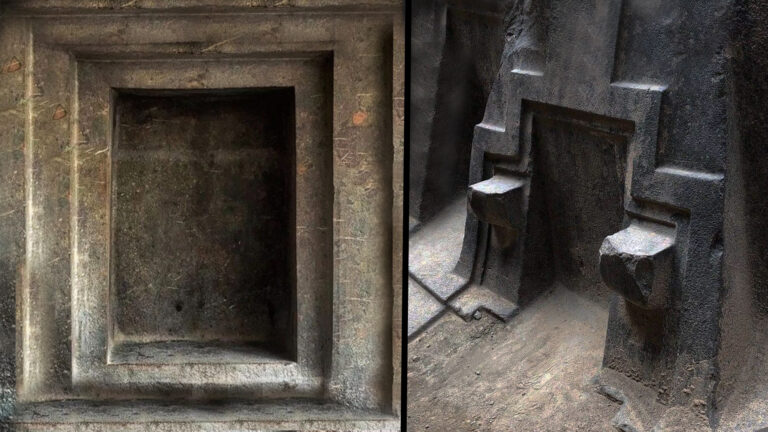
Near the blocked entrance stands the most iconic feature of Naupa Huaca — a false door carved directly into the rock face. This feature, often called an altar, appears to have been cut with technology far beyond the known capabilities of any ancient civilization in the region.
The door is carved from andesite, a volcanic rock with a hardness comparable to granite (around 7 on the Mohs scale). Working this stone using traditional Inca tools — made of stone or copper — would have been nearly impossible without leaving rough tool marks. Yet the surface of the Naupa Huaca false door is astonishingly smooth, with crisp geometric angles and polished planes.

Researchers such as Jay from The Voyager TV and Helder from Megalithic Evidence inspected the site under a microscope and found evidence suggesting that parts of the andesite were melted, forming a glossy, obsidian-like surface. To achieve such melting, temperatures exceeding 1,200°C (2,200°F) would be required — far beyond what could be produced by ancient wood or coal fires.
This has led some to propose that the stone was exposed to an unknown energy or heat source, possibly advanced technology from a prehistoric civilization. The absence of tool marks and the uniform smoothness of the cuts make the false door one of the most mysterious examples of megalithic stonework in the Americas.
Sacred Geometry and Astronomical Design
Nothing about Naupa Huaca seems random. The cave’s interior geometry follows precise ratios and angles that suggest a deep understanding of harmonics, geometry, and astronomy. The ceiling appears cleanly sliced, forming angles of 60° and 52°, the same pair of angles found in the two largest pyramids at Giza.
Measurements of the inner chamber reveal a 3:1 length-to-height ratio, corresponding to a perfect musical fifth, while the alcove follows a 5:6 ratio, producing a minor third. These ratios reflect harmonic resonance principles found in music and nature — evidence, perhaps, of an ancient civilization that viewed sound, mathematics, and architecture as interconnected forces.
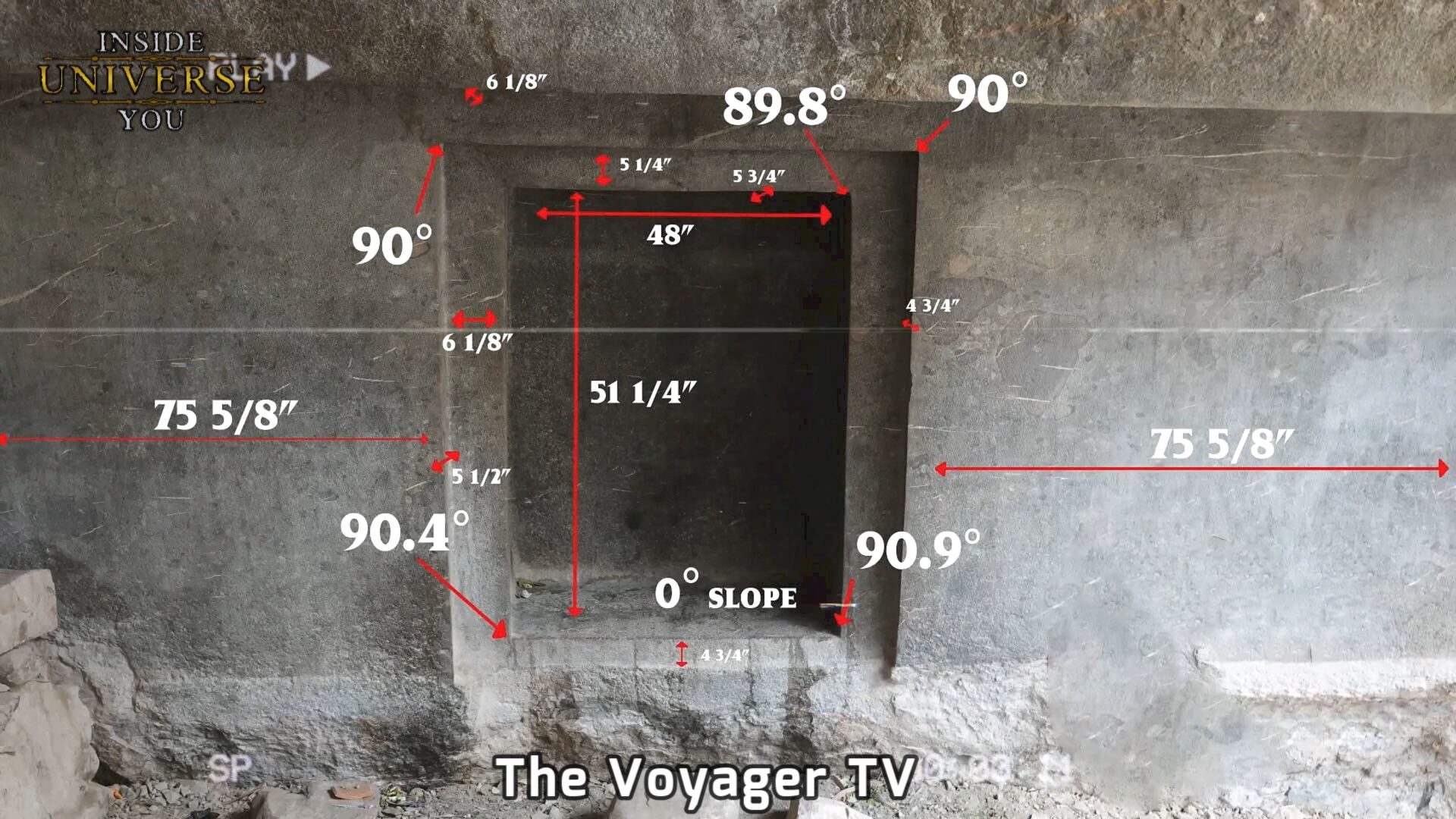
The 5:6 ratio also mirrors certain cosmic cycles: Earth’s axial precession (a 25,920-year rotation of the poles) and the equatorial tilt shift every 21,000 years, creating the same mathematical relationship. These correlations suggest that the builders of Naupa Huaca had a sophisticated awareness of Earth’s astronomical movements, similar to what’s encoded in Egypt’s Bent Pyramid.
The Destroyed Altar of Naupa Huaca
The most striking element inside Naupa Huaca is the so-called altar, carved from bluestone — the only outcrop of this mineral in the region. Bluestone is known for its piezoelectric and magnetic properties, meaning it can generate an electrical charge under pressure. This same material was used in early radio technology, and it’s believed by some that ancient builders understood these energetic properties.

The altar’s surfaces are perfectly flat, with right-angled cuts so clean they appear machined. Bronze-age tools would have struggled to achieve such precision without breaking or chipping the stone. Two large knobs protrude from the surface, reminiscent of the design seen at Ollantaytambo’s trapezoidal fountain, another megalith with suspected energy-related functions.
Unfortunately, the altar was partially destroyed by Spanish conquistadors in the 16th century, who reportedly used dynamite to deface the monument. However, the remaining drill hole in the center of the altar shows spiral grooves consistent with modern rotary drilling — evidence, some claim, that this feature was part of the original ancient construction rather than a later addition.

Adding to the intrigue, the altar aligns with several celestial events, including the rising of Sirius, the winter solstice, and key constellations. Whether this alignment served ceremonial, energetic, or astronomical functions remains an open question.
Who Built Naupa Huaca?
Mainstream archaeologists attribute Naupa Huaca to the Inca civilization, but the evidence suggests otherwise. The Inca were master stonemasons, yet their work — typically rough, polygonal, and mortarless — cannot compare to the mathematical precision of Naupa Huaca’s geometry.
The megalithic carvings here, with their smooth, mirror-like surfaces and impossible symmetry, appear to belong to an earlier, far more advanced civilization. Even today, replicating such stonework would be challenging with modern diamond tools and laser cutters.
It’s possible that the Inca merely inherited Naupa Huaca, recognizing its sacred significance and incorporating it into their spiritual traditions. Throughout history, newer cultures have built their temples upon the ruins of older sacred sites — perhaps Naupa Huaca was one such inheritance from an age long forgotten.

The Portal Hypothesis and Final Theories
The mystery of Naupa Huaca persists: was it a temple, an energy center, or a literal portal between dimensions? Some claim that the false door could serve as a vibrational gateway, activated by sound, resonance, or consciousness. Others see it as a technological relic of a civilization with knowledge of geophysics, magnetism, and harmonic energy fields.
Even if we strip away the more mystical theories, the sheer sophistication of Naupa Huaca forces us to reconsider what ancient people were capable of. Whether built for ritual, science, or survival, this site displays a union of geometry, astronomy, and spirituality that transcends time.
Perhaps Naupa Huaca truly lives up to its name — an Ancient Sacred Place, a surviving echo of a lost civilization whose understanding of energy, matter, and consciousness remains far beyond our own.