
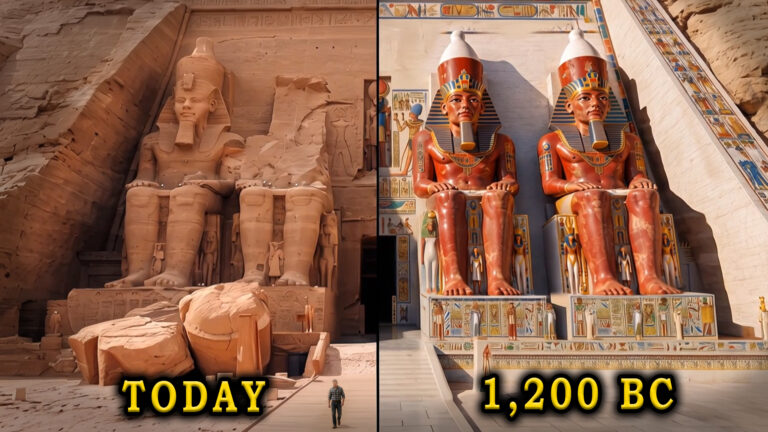

When most people imagine ancient Egypt, they picture weathered pyramids, faded sandstone temples, broken statues, and ruins slowly disappearing beneath the desert. But this is not how Egypt’s greatest monuments originally appeared. Thousands of years ago, many of these structures were covered in brilliant pigments, polished stone, painted reliefs, monumental statues, landscaped gardens, and surfaces designed to blaze beneath the Egyptian sun.
Modern ruins reveal the extraordinary scale of Egyptian architecture, but only traces remain of the visual world that once surrounded them. From the colossal temples of Abu Simbel to the shining pyramids of Giza, the enormous complex of Karnak, and the elegant terraces of Hatshepsut’s mortuary temple, reconstructed ancient Egypt would look dramatically different from the monochrome civilization most people know today.
Abu Simbel: A Mountain Transformed Into a Temple
For more than three thousand years, the colossal temples of Abu Simbel have watched over the Nile from the edge of the Nubian Desert. Today, their enormous statues appear in the familiar colors of weathered sandstone, but when the complex was created during the thirteenth century BC, visitors would have experienced something far more spectacular.

The temples were commissioned by Ramesses II, one of ancient Egypt’s most powerful pharaohs. Unlike the pyramids, Abu Simbel was not assembled from millions of individual blocks. Ancient builders carved the temples directly into a massive sandstone cliff, effectively transforming an entire mountainside into a monument.
Dominating the façade of the Great Temple are four colossal seated statues of Ramesses II, each standing more than sixty-five feet high. Today their exposed sandstone gives them a relatively uniform appearance, but the original temple incorporated vivid painted decoration. Color would have emphasized royal clothing, crowns, inscriptions, and architectural details, making the façade dramatically different from the monument seen today.

The transformation continued inside. The Great Temple penetrates more than two hundred feet into the mountain through monumental chambers covered in carved scenes and inscriptions. Brilliant reds, blues, yellows, greens, and whites originally covered many of these surfaces, while eight enormous Osiride figures of Ramesses II, standing more than thirty feet high, lined the main hall.

Perhaps Abu Simbel’s most famous feature is something that reconstruction cannot fully capture: its relationship with the sun. Twice each year, around February 22 and October 22, sunlight travels deep through the temple and reaches statues within the innermost sanctuary. Ramesses II, Amun-Ra, and Ra-Horakhty are illuminated, while Ptah, associated with the underworld, remains in darkness.
Remarkably, the temple visitors see today is no longer in its original location. Construction of the Aswan High Dam threatened to submerge Abu Simbel beneath Lake Nasser during the 1960s. Engineers dismantled the complex into more than one thousand enormous sections and reconstructed it on higher ground, preserving one of ancient Egypt’s greatest architectural masterpieces.

Karnak: The Largest Temple Complex of Ancient Egypt
If Abu Simbel was designed to overwhelm visitors with monumental scale, Karnak Temple took that idea even further. Expanded by generations of Egyptian rulers for more than two thousand years, Karnak eventually covered more than two hundred acres at ancient Thebes, modern-day Luxor.
Karnak was not simply one temple. It was an enormous sacred landscape containing pylons, sanctuaries, courtyards, obelisks, sacred lakes, statues, processional routes, and temples primarily dedicated to Amun-Ra.
Approaching Karnak during its prime would have been radically different from walking through the ruins today. Processional avenues lined with ram-headed sphinxes guided visitors toward gigantic gateways. Ceremonial flags flew from towering wooden poles, while architectural surfaces and carved reliefs displayed intense reds, blues, yellows, greens, and other pigments.

At the center of this architectural world stood the Great Hypostyle Hall, one of the most astonishing interior spaces ever created in the ancient world. Covering more than fifty thousand square feet, it contains 134 enormous columns, with the tallest reaching nearly seventy feet.
Their capitals were shaped like papyrus plants, connecting the temple symbolically with Egyptian creation mythology. Hieroglyphs, royal victories, religious rituals, offerings, and images of the gods covered the columns and surrounding walls. When the surviving pigments are mentally reconstructed across the entire hall, Karnak becomes less like a field of ancient stone and more like a monumental forest of painted architecture.

Karnak also contained enormous granite obelisks transported from Aswan hundreds of miles away. The surviving obelisk of Hatshepsut rises nearly one hundred feet and weighs more than three hundred tons. Its polished granite would have reflected the intense Egyptian sunlight, reinforcing the temple’s symbolic connection with the sun and the gods.

Luxor Temple: The Monumental Gateway of Thebes
Nearby Luxor Temple continued the monumental architectural language of Karnak and was connected to it through the famous Avenue of Sphinxes. Although smaller than Karnak, Luxor was still an enormous ceremonial complex filled with towering columns, colossal statues, courtyards, obelisks, and painted reliefs.
Visitors approached an imposing gateway dominated by colossal statues of Ramesses II and two enormous pink-granite obelisks. Only one remains there today. The second was transported to France during the nineteenth century and now stands at the Place de la Concorde in Paris.

Beyond the entrance were monumental courtyards and colonnades, including the Great Colonnade of Amenhotep III. Fourteen gigantic papyrus-shaped columns rise more than fifty feet high, while surrounding reliefs depict festivals, ceremonies, and offerings.
When reconstructed with its original painted decoration and polished architectural surfaces, Luxor Temple becomes almost unrecognizable compared with its modern appearance. Incense, music, chanting priests, processions, banners, and crowds would have further transformed the complex from a silent archaeological site into one of the great ceremonial centers of the ancient world.

The Great Sphinx and the Pyramids of Giza
Few ancient monuments have changed in appearance as dramatically as the Great Pyramids of Giza. Today, their exposed limestone cores create the familiar rough, stepped surfaces seen in photographs. Originally, however, the pyramids presented a far smoother and brighter appearance.
Their exteriors were covered with precisely fitted white Tura limestone casing stones polished to create smooth surfaces. Under the Egyptian sun, the completed pyramids would have appeared dramatically brighter than they do today, dominating the surrounding landscape from enormous distances.

The pyramidions at their summits may also have incorporated highly reflective materials such as electrum, an alloy of gold and silver. Instead of the brown and beige monuments familiar today, the Giza pyramids would therefore have appeared as enormous geometric mountains of brilliant pale stone.
Around them stood temples, causeways, statues, tombs, and ceremonial structures, creating an integrated monumental landscape rather than three isolated pyramids in an empty desert.
Beside them was the Great Sphinx, carved directly from the limestone of the Giza Plateau. Measuring approximately 240 feet long and more than sixty feet high, the Sphinx remains one of archaeology’s most recognizable monuments.

The mainstream archaeological interpretation associates its construction with Pharaoh Khafre around 2500 BC. Alternative theories have proposed much earlier dates and suggested that its current human head could have replaced an earlier lion or jackal head. These ideas remain disputed and should be distinguished from the conventional archaeological reconstruction of the monument.
What is clear is that ancient Giza was far more visually elaborate than its surviving ruins suggest. A reconstructed plateau with smooth white pyramids, decorated temples, ceremonial causeways, statues, and painted architectural elements reveals why Giza must have been one of the most extraordinary human-made landscapes on Earth.

The Temple of Hatshepsut: Ancient Egypt in Full Color
Rising beneath the enormous limestone cliffs of Deir el-Bahri, the Mortuary Temple of Hatshepsut remains one of ancient Egypt’s most distinctive architectural achievements. Built during the fifteenth century BC, it was designed for Hatshepsut, one of the few women to rule ancient Egypt as pharaoh.
Rather than relying on massive pylons alone, the complex was constructed across three monumental terraces connected by broad central ramps. Long colonnades created extraordinary symmetry, while the surrounding cliffs became part of the architectural composition.

The surviving pale stone, however, tells only part of the story. Originally, painted reliefs covered the temple in reds, blues, greens, yellows, and other vivid colors. Statues lined the terraces, while chapels dedicated to Amun, Hathor, and Anubis formed part of the sacred complex.
The surrounding landscape was also dramatically different. Archaeological evidence suggests that the temple’s forecourt incorporated ornamental gardens, pools, flowering plants, and imported frankincense and myrrh trees associated with Hatshepsut’s expedition to the Land of Punt.

These gardens are particularly important when reconstructing the monument. Instead of imagining an isolated stone temple surrounded entirely by barren desert, visitors would have approached an elaborate ceremonial landscape combining architecture, vegetation, water, painted decoration, statues, and the towering natural cliffs.
Colossal representations of Hatshepsut once stood throughout the complex, often depicting her with the traditional symbols of Egyptian kingship, including the royal false beard. The temple celebrated not only religion but also trade, prosperity, royal legitimacy, and Hatshepsut’s extraordinary reign.
In its reconstructed state, the Temple of Hatshepsut may have been one of the most visually beautiful monuments anywhere in the ancient world.

Saqqara: Where the Age of the Pyramids Began
Long before the Great Pyramid dominated Giza, Egyptian builders were already experimenting with monumental stone architecture at Saqqara. Located around twenty miles south of modern Cairo, Saqqara served as the principal necropolis of ancient Memphis for thousands of years.
Its most famous monument is the Step Pyramid of Djoser, constructed during the twenty-seventh century BC and traditionally associated with the architect Imhotep. Rising more than 200 feet, its six monumental levels represented a revolutionary development from earlier mastaba tombs toward the true pyramids that would follow.

Yet much of Saqqara’s architecture is hidden underground. Beneath Djoser’s pyramid stretches a vast labyrinth containing more than three miles of tunnels, chambers, galleries, and storage rooms. Some passages descend nearly one hundred feet beneath the desert, creating an enormous subterranean component invisible from the surface.
Saqqara also preserves hundreds of decorated tombs whose surviving pigments provide important evidence for reconstructing ancient Egyptian architecture. Scenes of farming, hunting, fishing, music, feasting, shipbuilding, religious ceremonies, and daily life were painted in vivid colors rather than left as bare stone.
Recent excavations continue to reveal burial shafts, painted coffins, statues, gilded masks, mummies, and sacred-animal cemeteries. Significant areas of Saqqara remain beneath the sand, meaning our picture of this enormous necropolis continues to evolve.
The Colossi of Memnon and a Lost Mega-Temple
The Colossi of Memnon appear strangely isolated today: two gigantic seated figures rising from otherwise relatively open terrain near Luxor. That isolation is misleading.
The statues originally guarded the entrance to the enormous Mortuary Temple of Amenhotep III, once among the largest temple complexes in Egypt. Each colossal figure stands roughly 60 feet high, approaching 70 feet with its pedestal, and weighs an estimated 720 tons.

Even more astonishing is the journey of the stone itself. The quartzite was transported from quarries near modern Cairo, roughly 420 miles away. Ancient engineers somehow moved these gigantic masses to their final location and erected them without modern cranes or powered machinery.
Most archaeologists believe combinations of sledges, barges, ropes, manpower, and carefully prepared transport routes made such operations possible. Nevertheless, reconstructing the surrounding temple reveals the real purpose of the statues: they were monumental guardians marking the entrance to an architectural complex that has almost completely disappeared.
What Ancient Egypt Actually Looked Like
The greatest misconception about ancient Egyptian architecture may be created by the ruins themselves. Thousands of years of erosion, flooding, earthquakes, looting, deliberate destruction, pigment loss, and stone reuse have stripped these monuments of much of their original appearance.
Ancient Egypt was not simply a civilization of beige stone.
Its monumental world contained brilliantly painted temples, polished limestone, enormous granite obelisks, colorful hieroglyphs, decorated statues, monumental gateways, landscaped gardens, sacred pools, processional avenues, towering columns, and pyramids whose smooth white casing reflected the desert sun.

Reconstructing these monuments therefore does more than make ancient ruins visually impressive. It changes our perception of the civilization that created them. Abu Simbel, Karnak, Luxor, Giza, Saqqara, the Temple of Hatshepsut, and the lost temple behind the Colossi of Memnon were designed as immersive environments where architecture, color, religion, astronomy, landscape, and royal power worked together.
What survives today is extraordinary. But when we reconstruct how ancient Egypt’s megastructures actually looked, the civilization that emerges is even more spectacular.