
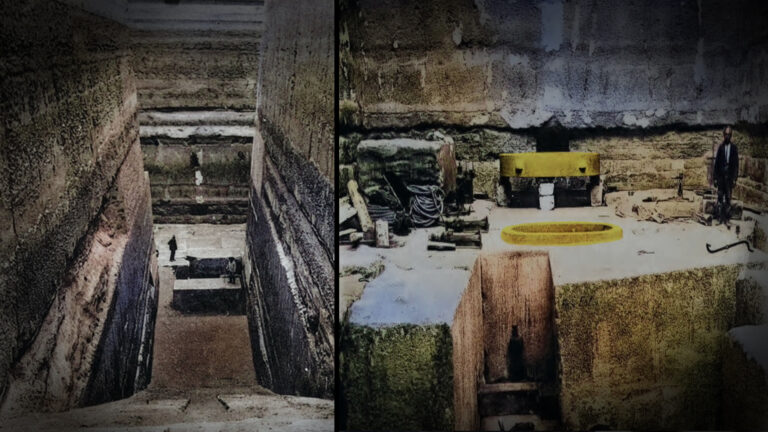

The mysterious site of Zawyet El Aryan, situated between the Giza plateau and Abu Sir, has been a subject of considerable intrigue and speculation, particularly due to the fact that the Egyptian government restricted access to this site and completely buried it, denying any archaeological investigations. The only information we have about this incredible site is from Egyptologist Allesandro Barsanti, who investigated the site in the early 20th century before access to the site was completely restricted.

The level of architectural sophistication evident at Zawyet El Aryan has given rise to theories suggesting that it may have been built by a technologically advanced civilization, possibly predating the conventional timeline of ancient Egyptian history.
The primary structure at Zawyet El Aryan is often referred to as the Unfinished Pyramid. It consists of a square base measuring approximately 650 feet on each side, with a deep, T-shaped central shaft cut into the bedrock. This shaft, which descends about 100 feet below ground level, is an engineering marvel in itself, considering the hardness of the bedrock and the precision required to excavate such a structure. The precision and scale of this excavation pose significant questions about the tools and technologies available to the ancient Egyptians. The conventional understanding of Egyptian toolsets, primarily composed of copper and stone tools, seems inadequate to undertake such an ambitious and precise project.

Theories suggesting that Zawyet El Aryan was built by a technologically advanced civilization are fueled by several factors. Firstly, the precision of the excavation work is extraordinary, with the shaft’s walls being almost perfectly vertical and smooth. This level of precision suggests the use of advanced surveying equipment and cutting tools, possibly hinting at a level of technological sophistication not yet acknowledged in ancient Egyptian history. The argument is further supported by the lack of any hieroglyphics or inscriptions at the site, which is unusual for Egyptian monumental structures and leaves the pyramid’s purpose and the identity of its builders shrouded in mystery.
The strange thing about the site was that the pit was intentionally filled with a tangled mass of heavy limestone blocks, hinting at a deliberate effort to conceal or protect whatever lay beneath. After excavating the limestone blocks with which the site was buried, Barsanti and his team found a massive foundation of pink granite blocks, which differed from the previously uncovered limestone blocks. One of these blocks was enormous, weighing around 30 tons.

The discovery of this granite block, along with subsequent findings of more granite blocks and an enormous 30-ton pink granite block forming the foundation of a sort of pavement, led Barsanti to believe that he had found the entrance to a subterranean world, possibly filled with untold treasures or significant historical artifacts. One of the most remarkable discoveries at the Zawyet El Aryan site was a large oval vat made of pink granite, polished like a mirror and intricately carved out of one of the pavement blocks. The vat’s protection, involving a layer of lime and a thick bed of well-spread clay, suggests it held great importance, possibly containing something of value or significance. The side walls of the vat were lined with a black band, possibly the residue of some liquid, pointing to its use in a unique and unknown process.
The vat’s design and the evident efforts to preserve its integrity suggest it was an integral part of a sophisticated process, possibly related to energy generation or storage. The black band lining the vat’s walls might be the residue of a chemical reaction or some form of energy conversion process. During the excavation of the site by Barsanti and his team in 1905, a massive storm hit Egypt and the pit at Zawyet El Aryan. The torrential rains filled the pit with over 10 feet of water. Incredibly, a few hours after the storm, the water level in the pit abruptly dropped. Surely, Barsanti asserted, this must be because the water was seeping down into some sort of subterranean chamber, into the hidden apartments he believed were waiting to be found beneath the pit.

Between the weight of the blocks, the cement-like mortar, and the interlocking pattern, the work was the most difficult his team had ever undertaken. But to Barsanti, this only proved his point. Surely, whoever had constructed the site had gone to such great lengths to make the blocks of the floor unmovable because they were meant to conceal a hiding place, something extremely important.
Unfortunately, the work was so difficult that, again, Barsanti ran out of money before he could solve the mystery. Then World War I broke out, shutting the sites of Egypt down to further exploration. In 1917, Barsanti unexpectedly died at the age of 59. Rather than continue Barsanti’s work, Egyptologists simply forgot about the site, leaving the mystery of what lay beneath it unsolved.

The sudden restriction of access to the Zawyet El Aryan site by the Egyptian government in the 1960s, just as interest in its mysteries was renewed, only deepens the intrigue. A military base now stands over the site, and no one can enter it. While definitive proof remains elusive, the architectural complexities and unexplained features of the Zawyet El Aryan site, coupled with its proximity to the Great Pyramid, suggest that it may have been part of an advanced technological system for energy generation and distribution in Ancient Egypt.

