
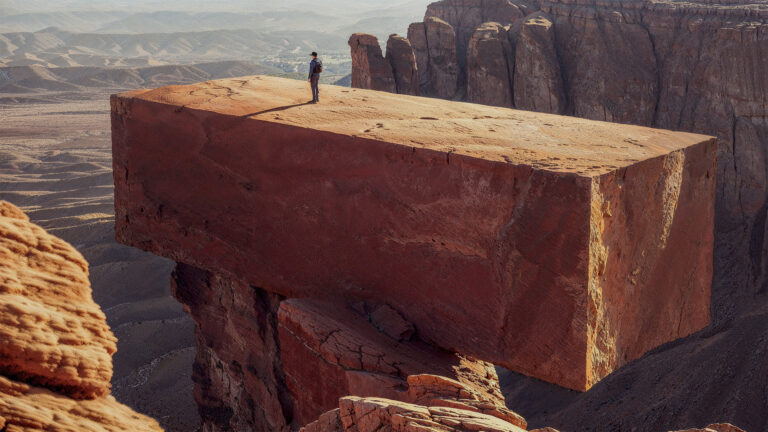

Monument Valley, located on the Arizona–Utah border within the Navajo Nation Reservation, stands as one of the most iconic landscapes of the American Southwest. Its towering sandstone buttes and mesas, reaching nearly 1,000 feet into the sky, have become enduring symbols of the Wild West. Carved by millions of years of wind and water erosion, these breathtaking formations are a natural masterpiece sculpted by time itself.
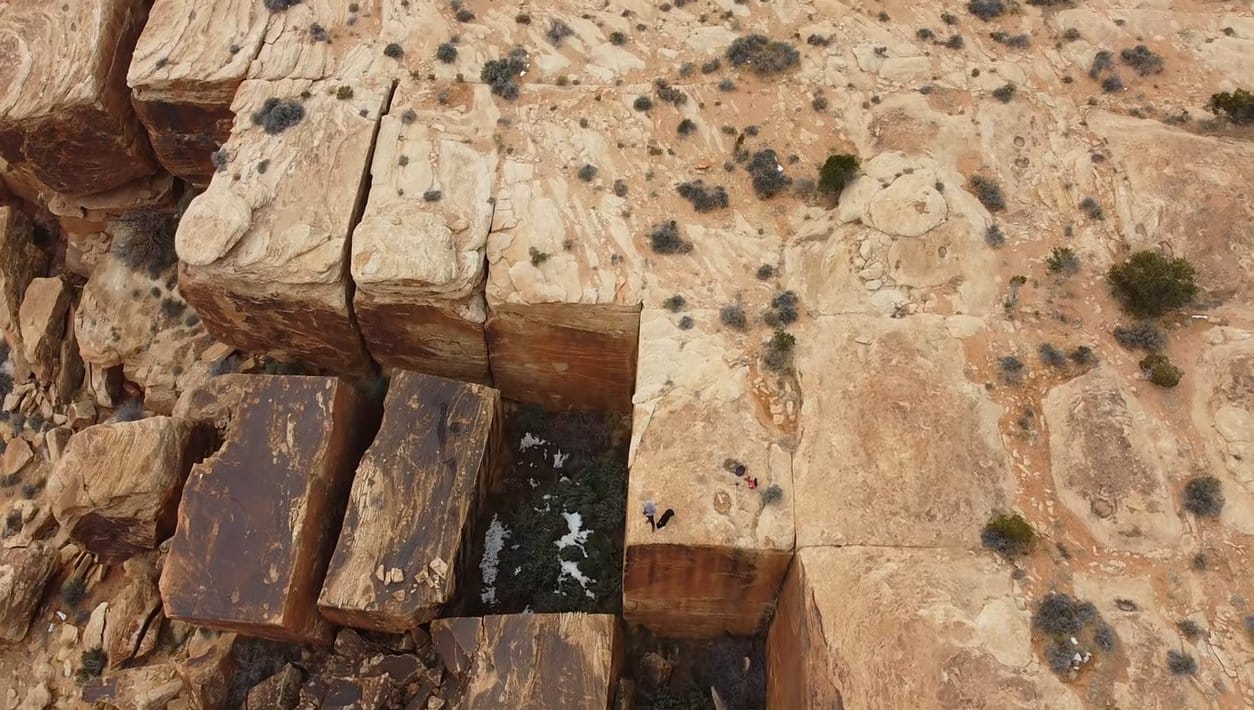
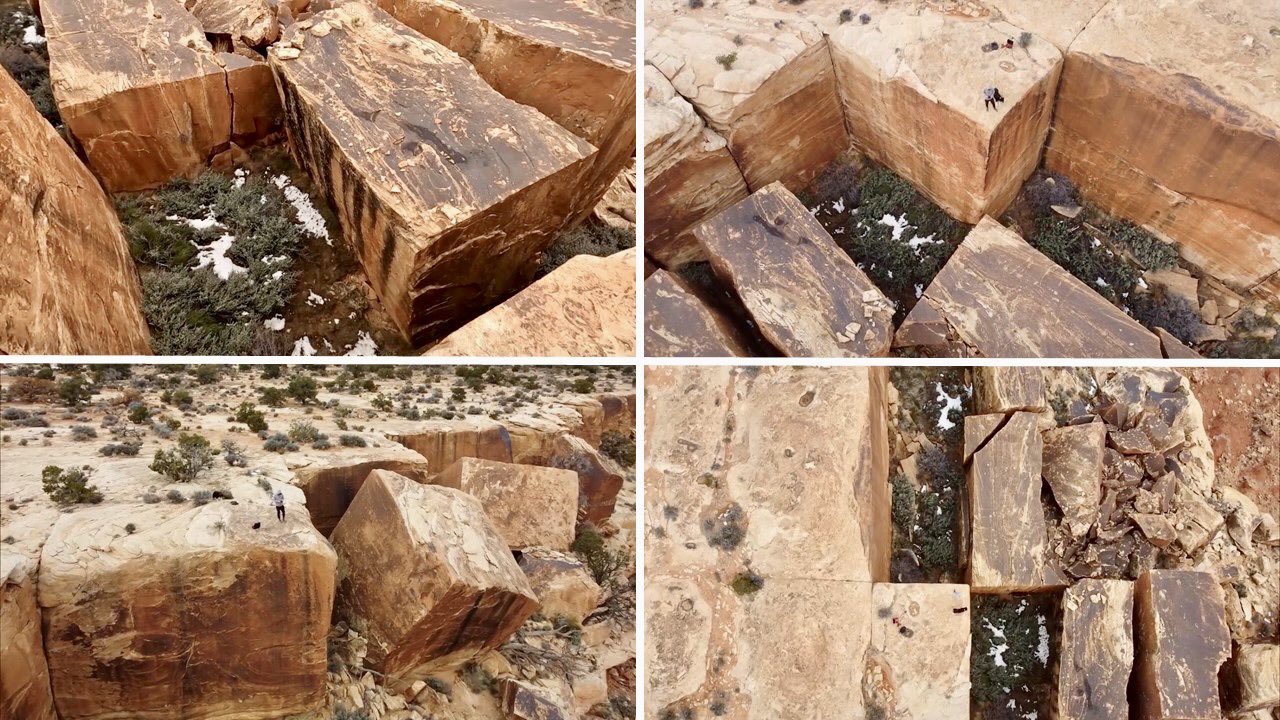
Yet, north of Monument Valley lies a far more puzzling site—one that defies the logic of mere natural erosion. Here, the sandstone appears in perfectly rectangular and cubic blocks, aligned with striking geometric precision. Each block seems to have been cut with mechanical accuracy, featuring flawless 90-degree angles, smooth surfaces, and laser-straight edges. To many who have seen it, this mysterious site appears less like a geological formation and more like the remains of an ancient stone quarry engineered by an advanced prehistoric civilization.
The “Giant Lego Blocks” of Monument Valley
The mysterious sandstone site gained attention after being featured by Nolan Fisher on his POVchannel on YouTube, who compared the formation to a field of giant Lego blocks. What intrigued viewers was the sense that some blocks were missing, as though once intentionally removed. Upon closer inspection, measurements revealed that several cubic blocks measure 21 feet per side, weighing an estimated 670 tons each, with some rectangular ones potentially reaching 900 tons. The precision of these sandstone monoliths—so cleanly segmented as if awaiting extraction—raises a compelling question: Was this an enormous ancient quarry?
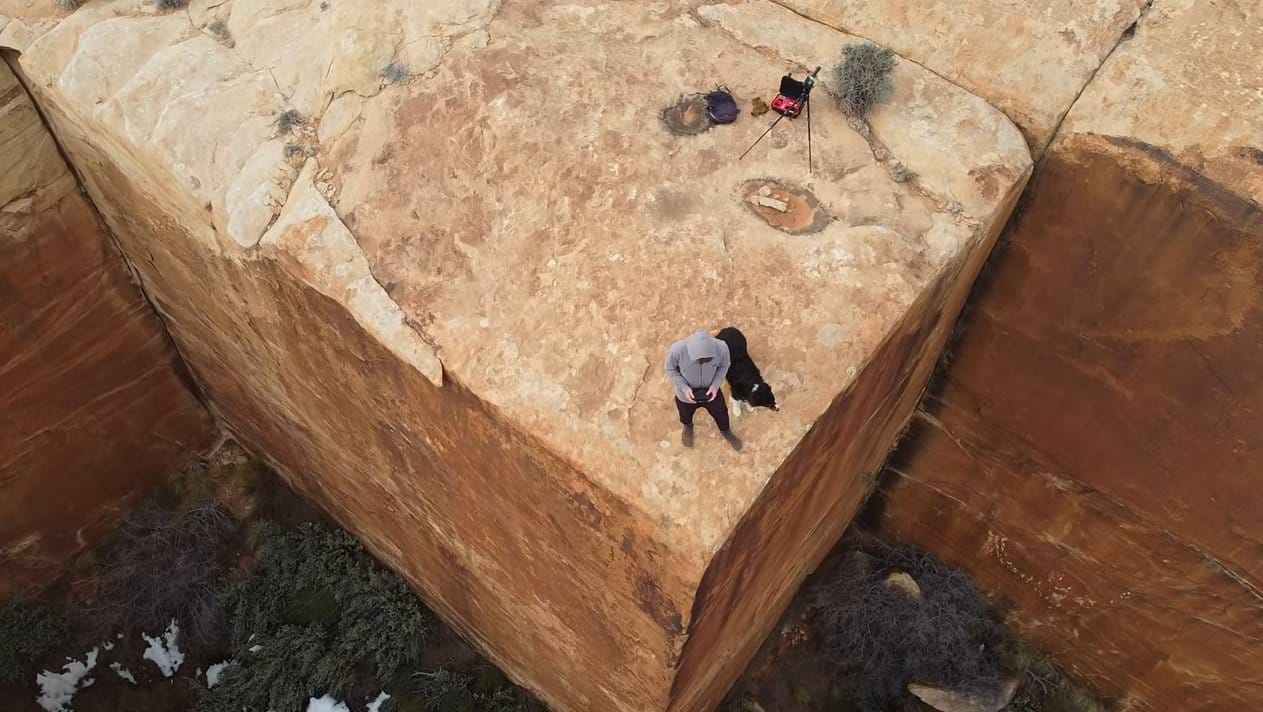
Sandstone is a sedimentary rock composed mainly of sand-sized minerals like quartz and feldspar. It typically fractures unevenly and does not form smooth cubes by itself. The precision seen here challenges the notion of random natural formation and instead hints at deliberate engineering, or at least, an unknown geological process of astonishing regularity.
Navajo Legends and the Sacred Meaning of the Stones
Adding another layer of mystery, the site also contains ancient petroglyphs—drawings of humanoid figures and the spiral symbol, a sacred motif in Navajo cosmology representing the cyclical nature of time. To the Navajo people, Monument Valley and its surrounding formations were not created by erosion but by the Holy People—divine beings who shaped the world. According to their tradition, the massive stone buttes are the petrified remains of ancient beings punished by the gods for their hubris, now serving as guardians of the land.
In Navajo mythology, the world has passed through multiple cycles or worlds, each ending in destruction. The first worlds fell to chaos and conflict; the third perished in a great flood, echoing the story of Noah’s Ark. The Navajo Flood myth mirrors countless global flood legends—from Mesopotamia to Mesoamerica—suggesting a shared memory of a cataclysm that may have destroyed a forgotten advanced civilization. Could the precision-cut blocks north of Monument Valley be remnants of such a civilization, erased by a global flood?
Interestingly, coral fossils are visible across parts of the site, supporting the idea that the area was once submerged underwater—perhaps during or after a prehistoric deluge.
Monument Valley and the Global Megalithic Mystery
The geometric perfection of these sandstone blocks invites comparison with other ancient megalithic sites worldwide—most notably Baalbek in Lebanon. At Baalbek’s Temple of Jupiter, the Trilithon stones—each weighing about 800 tons—form one of the greatest engineering enigmas of antiquity. Even today, modern cranes struggle to move stones of such magnitude. Yet these megaliths were cut, transported, and precisely placed thousands of years ago with techniques that remain a mystery. Nearby lies the “Stone of the Pregnant Woman,” weighing over 1,000 tons, believed to be part of an unfinished quarry block.
Archaeologists agree that later civilizations—the Phoenicians, Greeks, and Romans—built upon older foundations at Baalbek, yet none could match the precision or scale of the base megaliths. If those stones are acknowledged as man-made, could the geometric sandstone blocks in the Navajo Nation represent a similar legacy—the last traces of a lost master builder culture?
Could the Blocks Be Natural After All?
Despite their uncanny geometry, there remains a scientific argument for natural formation. Sandstone block structures can emerge naturally through a combination of lithification, tectonic uplift, and erosion. Over millions of years, layers of sand compact and cement together under pressure. When these layers are exposed at the surface, joints and bedding planes—natural fractures in the rock—can cause the sandstone to weather into block-like shapes. Erosion from wind, water, and temperature cycles can accentuate these fractures, giving the illusion of precision-cut stones.
Still, even geologists admit that the uniform size and near-perfect angles of the Navajo formations are unusually precise. Such perfection challenges the limits of known geological symmetry and continues to fuel speculation that some kind of intervention—natural or intelligent—occurred.
Nature’s Geometric Masterpieces Around the World
The Earth is filled with natural wonders that seem to mirror human craftsmanship. One striking example is Giant’s Causeway in Northern Ireland, a coastal plateau of roughly 40,000 interlocking basalt columns. Formed 50–60 million years ago by volcanic activity, its hexagonal pillars look as though carved by human hands. Across the Atlantic, Devils Postpile National Monument in California displays similar columnar basalt formations, towering over 60 feet high, resembling a cathedral of geometric stone.
In Iceland, the Svartifoss waterfall cascades between perfect black basalt columns, inspiring countless architectural designs. Likewise, Fingal’s Cave on the island of Staffa, Scotland, reveals identical volcanic hexagons that form a natural cathedral of stone. Even in Central Europe, Panská Skála in the Czech Republic—known as “Lord’s Rock”—features a cluster of upright basalt columns resembling the pipes of a grand organ.
These formations are all proof of nature’s ability to sculpt geometry, but none exhibit the clean-cut rectangular symmetry found in the sandstone blocks of the Navajo Nation. This distinction continues to intrigue researchers, blurring the line between geological formation and ancient engineering.

A Sacred Puzzle Carved in Stone
The Navajo desert holds its secrets close. The combination of sacred mythology, archaeological enigmas, and geometric perfection paints a picture that challenges both science and spirituality. If the site north of Monument Valley is a natural wonder, it stands among the most precise in the world. But if it was carved—by human hands or by an ancient civilization long forgotten—it may represent one of the oldest quarries on Earth, predating recorded history.
Either way, this mysterious site reminds us that the Earth itself is a living archive, containing both geological marvels and echoes of lost worlds. Whether shaped by nature or intelligence, the stone blocks of the Navajo Nation compel us to look deeper into our planet’s past—and perhaps reconsider what we truly know about the ancient history of North America.