
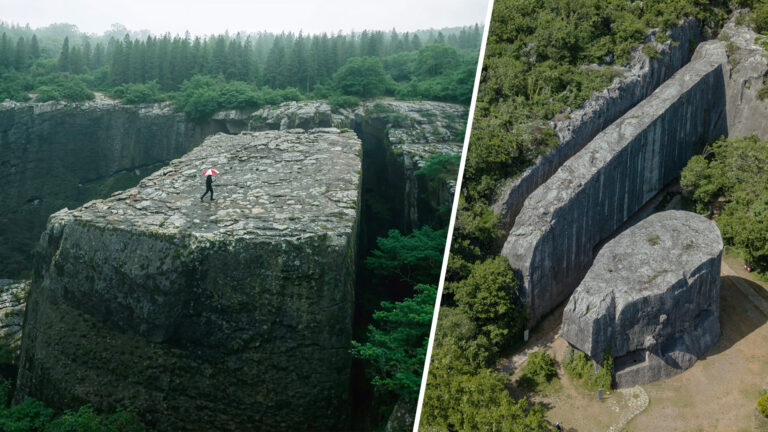

The Yangshan Quarry, nestled in the outskirts of Nanjing, China, is a trove of archaeological enigmas and construction anomalies that defy conventional understanding of ancient engineering. The centerpiece of this mystery is the gargantuan 16,000-ton megalithic block, making it the largest known stone ever cut by human hands.
To put its enormity into perspective, it is over thirteen times heavier than the largest megalithic block in Baalbek. The logistics of cutting, extracting, and transporting a stone of this magnitude are staggering. Even with today’s technology, moving a 16,000-ton block would be an impossible task—even with fleets of cranes and heavy machinery. This raises the question: What kind of technology did this ancient civilization possess to move such enormous stones?
Lost Technology at the Yangshan Quarry
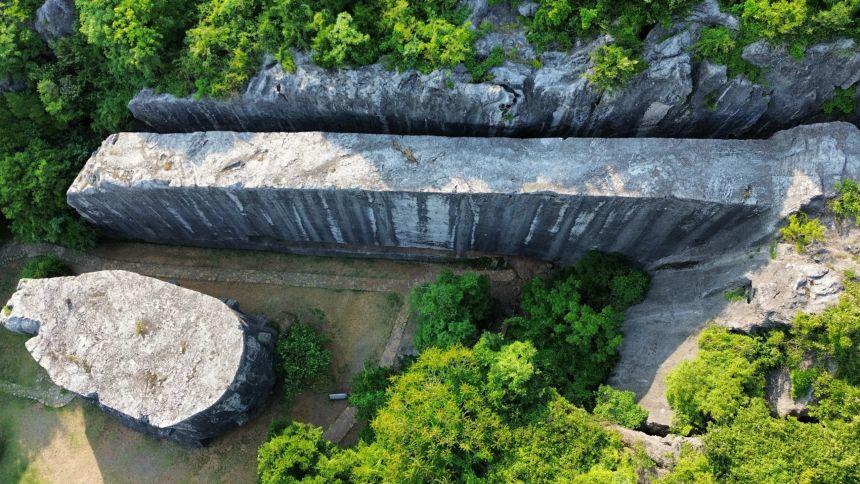
It’s evident that this massive stone block wasn’t the only one. Millions of tons of rock appear to have been displaced already, leaving towering flat walls that defy traditional quarrying practices. Whoever operated this quarry clearly had the ability and technology to transport massive blocks, but the methods used to cut and shape these stones remain a mystery.
At the base of the giant stone, there are massive square holes, likely intended for lifting or transport mechanisms. The precision and clarity of the quarry marks, combined with smooth planned surfaces, suggest a level of sophistication far beyond what ancient civilizations are believed to have possessed.
The straight, precise grooves and the sheer size of the block imply an advanced mastery of stonework, one seemingly impossible for the ancient world. The erosion patterns also suggest that the Yangshan megaliths are extremely old—possibly much older than 8,000 years.

Precision Cuts, Square Cavities, and Mysterious Knobs
The quarry site contains other structures, including perfectly squared cavities carved into solid rock, featuring sharp 90-degree angles and smooth surfaces that would be impossible to create with simple bronze tools.
Adding to the enigma are the large, knob-like protrusions found on many of the finished stones. Ancient megalithic sites around the world—such as those in Peru, Egypt, and Cusco, and even the Menkaure Pyramid in Giza—feature similar knobs, suggesting a shared symbolic or technological function among prehistoric builders.
Mainstream archaeologists suggest these knobs were used as lifting points, but given the enormous scale of the blocks in Yangshan, this explanation seems insufficient. The consistency of this feature across global megalithic sites hints at a common lost technique or purpose.

A Global Pattern of Unfinished Megaliths
How is it possible that we can find gigantic unfinished stone blocks in various parts of the world—all suddenly left mid-construction and untouched for thousands of years?
At the Aswan Quarry in Egypt, the Unfinished Obelisk weighs approximately 1,200 tons. This massive piece of granite was carved directly from bedrock but never completed, suggesting a sudden halt in construction. Similarly, at the Minya Quarry, enormous limestone blocks remain partially detached from bedrock, some estimated to weigh around 5,000 tons.

At Baalbek, the Trilithon stones forming the podium of the Temple of Jupiter each weigh about 800 tons, and another nearby block—known as the Stone of the Pregnant Woman—weighs around 1,000 tons. For unknown reasons, these blocks were abandoned mid-quarry.
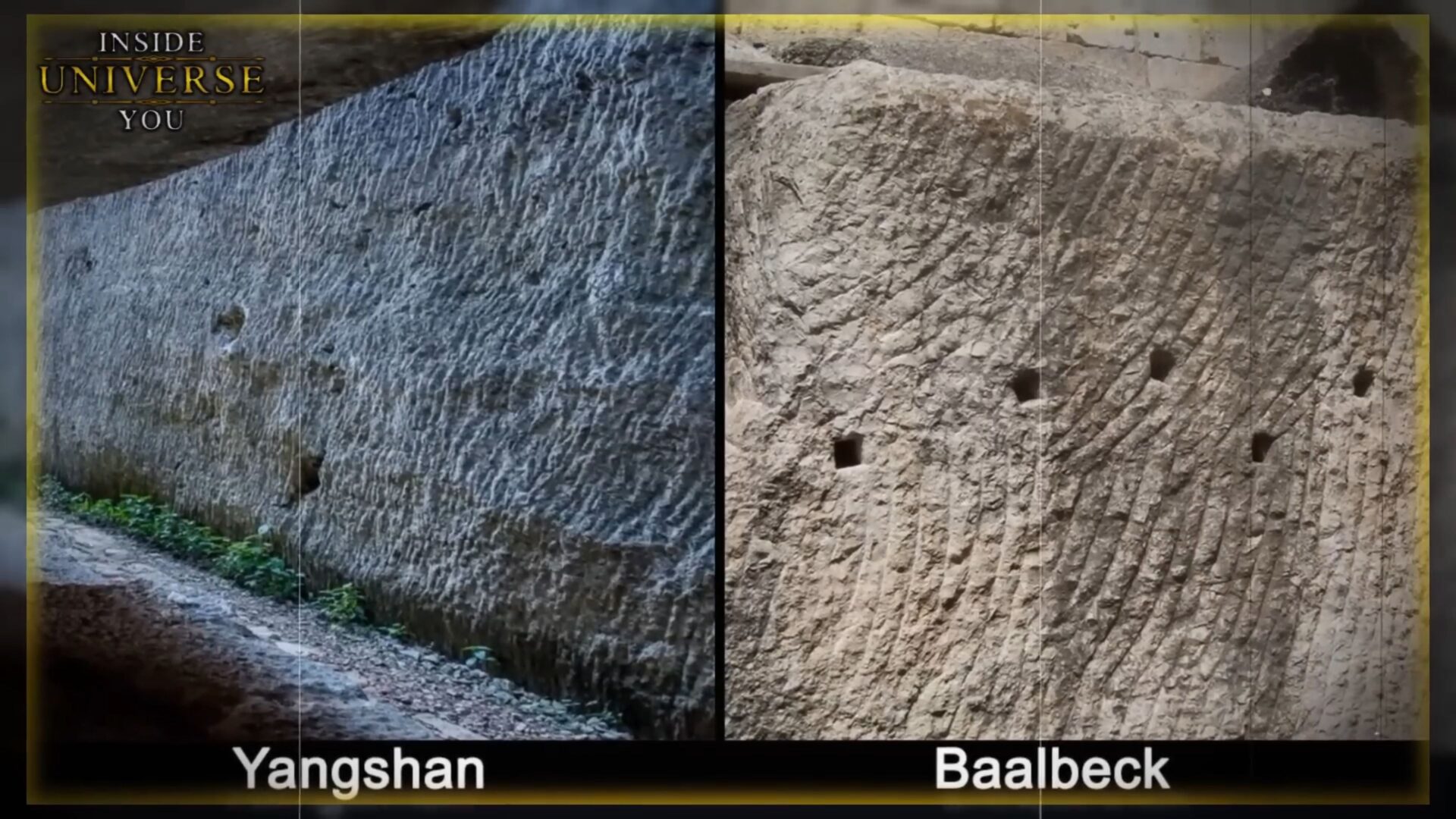
Curiously, the Yangshan Quarry in China displays the exact same toolmarks seen on the massive stones at Baalbek in Lebanon. The resemblance between the striations, grooves, and patterns on these two distant sites is uncanny, as if the same techniques—or even the same tools—had been employed.
Similarly, at the ancient city of Petra in Jordan, toolmarks closely resembling those found on the Yangshan blocks have been identified. Petra, which dates back to as early as 7000 BC, features sedimentary rock formations etched with striations nearly identical to those in Yangshan, despite being composed of entirely different rock types.
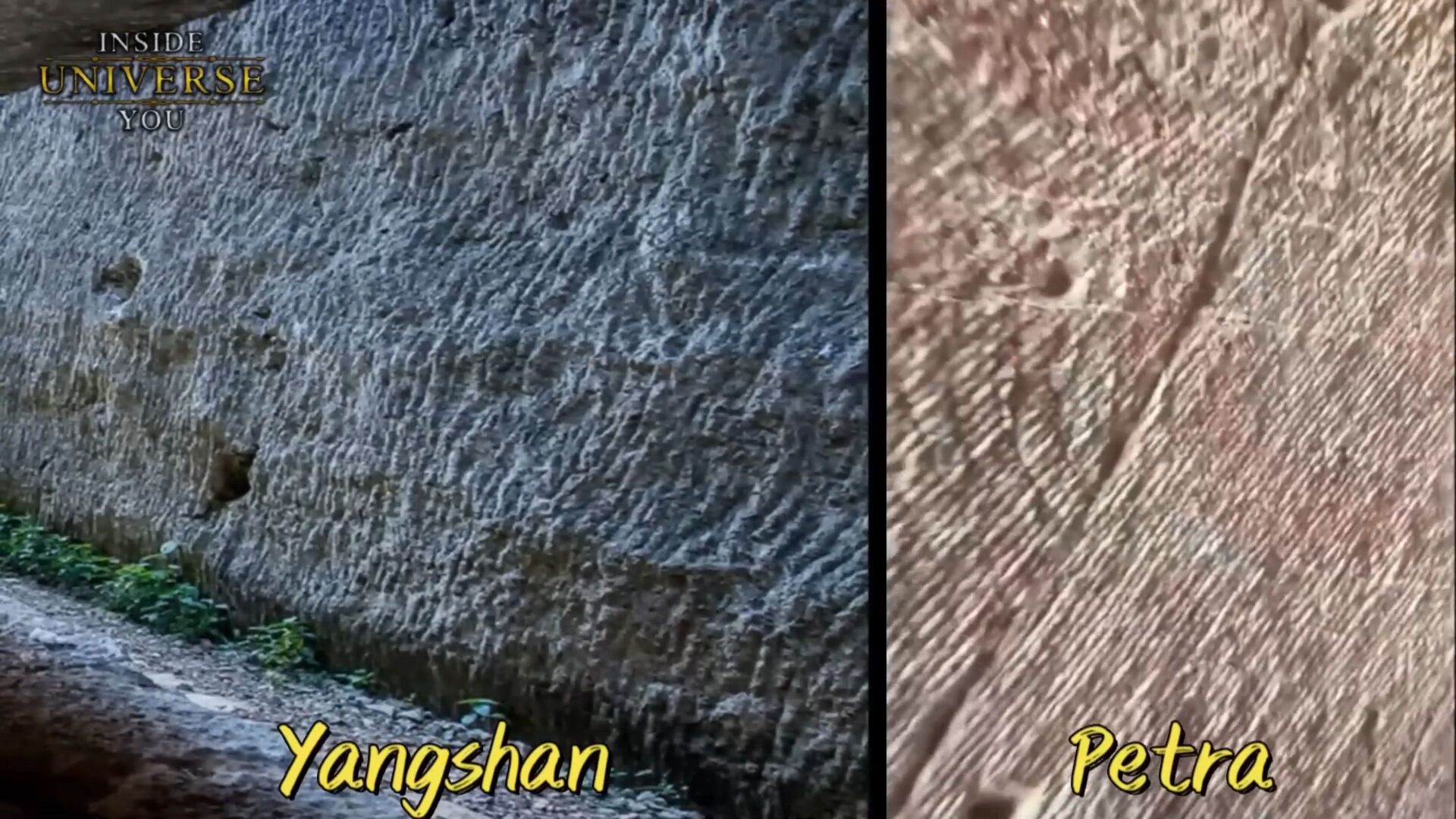
What makes this even more astonishing is that when these ancient toolmarks are compared to the cutting patterns of modern machinery, such as those produced by industrial saws and excavation equipment, the similarities are striking. The precision, depth, and uniformity of these marks suggest the use of rotational or high-frequency cutting technology, far beyond what is typically attributed to the ancient world.
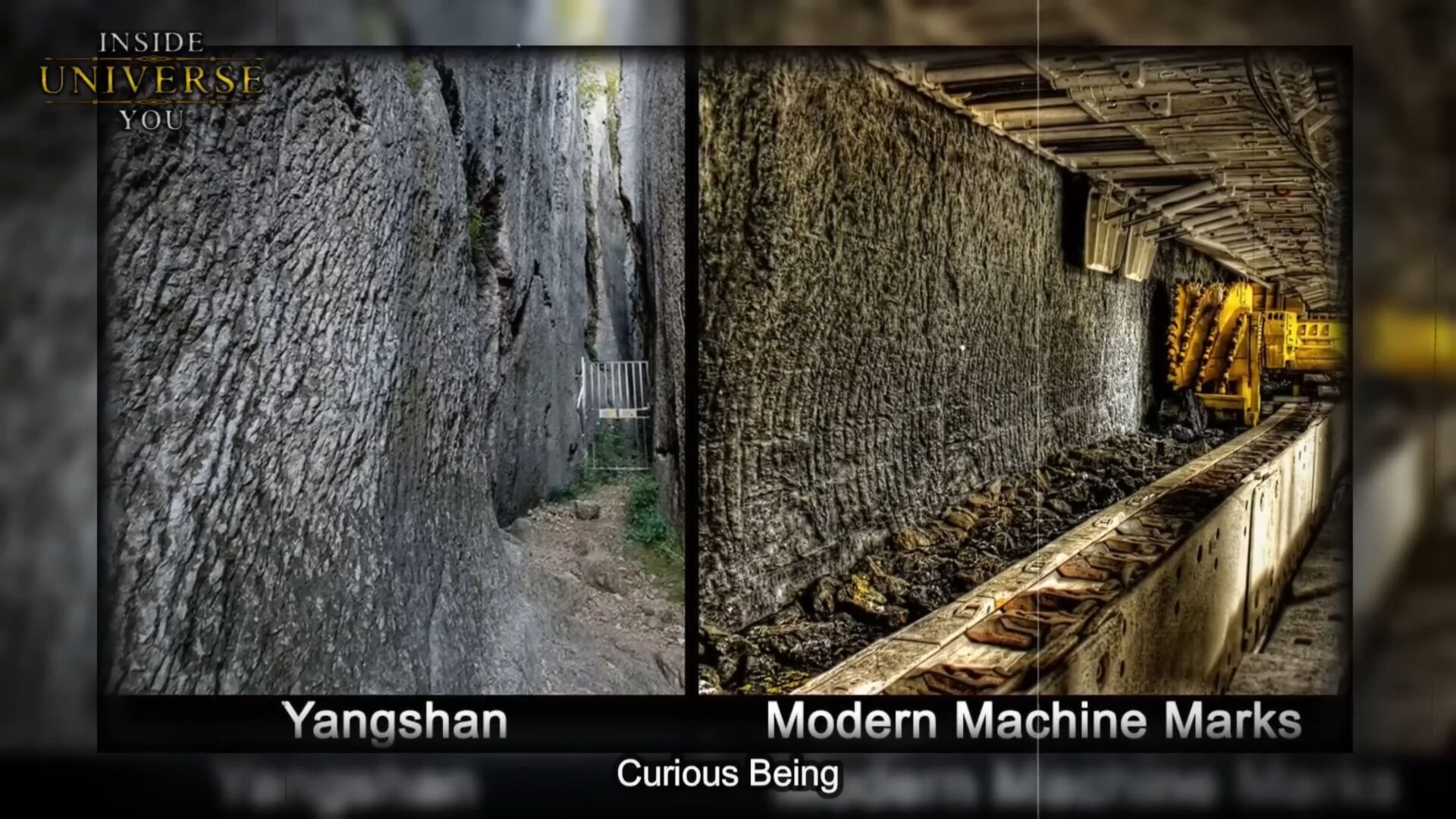
This uncanny parallel between sites separated by thousands of miles and built from different materials raises profound questions about the technological capabilities of ancient civilizations. It suggests that these cultures may have possessed advanced engineering knowledge—perhaps even global connections or shared technologies—long before modern history acknowledges such sophistication.

In the Aswan Quarry, another colossal granite slab measuring 137 feet long and weighing 1,170 tons was also left unfinished, its surface appearing “scooped out” in a manner that seems almost mechanical.
The Minya Quarry (Tura) contains another partially carved limestone block, still attached to the bedrock, once again suggesting that work was suddenly abandoned.
The presence of these massive, unfinished megaliths across different regions—China, Egypt, and Lebanon—raises profound questions about the capabilities and fate of these ancient civilizations.
The sheer size of the stones and the advanced quarrying techniques required to produce them indicate a level of technological sophistication that defies mainstream archaeological timelines.
The recurrence of abandoned projects in these sites has led some researchers to theorize that a cataclysmic global event—perhaps an environmental or cosmic disaster—may have caused a sudden worldwide collapse of the civilizations engaged in these monumental undertakings.
It appears that these advanced builders were abruptly halted in their tracks, leaving behind monolithic witnesses to their lost grandeur and forgotten technological mastery.
Conclusion
The Yangshan Quarry stands as one of the greatest unsolved enigmas of the ancient world. Its 16,000-ton megalith, perfectly cut yet never moved, embodies the mystery of ancient engineering and the shared silence of abandoned megastructures across the globe.

Whether the result of lost technology, forgotten knowledge, or a cataclysm that erased entire civilizations, the Yangshan Quarry challenges our very understanding of human history and the technological limits of the ancient past.
